 Guide to the Azores
São Miguel or Terceira: Which Azores Island Deserves the Trip?
São Miguel or Terceira is the island question for anyone who cannot visit the whole archipelago. São Miguel is the big one, with the crater lakes, the hot springs and most of the flights. Terceira is the compact one, with a UNESCO city, a lava chimney you walk into, and a gentler pace. Our islands guide holds the whole nine-island picture, the Terceira guide and Angra do Heroísmo guide cover the smaller island in detail, and this page compares the two head to head for a first trip. The rest of the archipelago is on Guide to the Azores.
Quick answer The one-paragraph island verdict
For a first Azores trip, pick São Miguel: it holds the headline scenery, the Sete Cidades twin lakes, the Furnas hot springs, year-round whale watching, and the archipelago's densest flight network. Pick Terceira if a UNESCO city and a walk-in volcanic cave outrank a checklist of viewpoints, or if you are flying from North America, which lands directly at Terceira too. There is no ferry between them, Ponta Delgada appears on no Atlânticoline route, so seeing both in one trip means a flight and a half-day of transferring.
Key takeaways
- São Miguel fits four to five days of sightseeing without repeating itself, while Terceira's headline sights fit two to three, which our islands guide reads island by island.
- Terceira's Angra do Heroísmo has been a UNESCO World Heritage site since 1983, and the Algar do Carvão lava chimney costs $11.46 (€10) to enter.
- São Miguel's west van day, its most reviewed tour, runs $97.57 against $99.87 for Terceira's full-day circuit, so guided costs are near-identical.
- The two islands connect by Azores Airlines flight only, because the ferries work the Faial, Pico and São Jorge triangle and skip Ponta Delgada entirely.
The Two Islands Side by Side
Figures come from UNESCO records, the venues' own official pages and the platform's tour listings, compared across the six things a first-time planner actually weighs.
| São Miguel | Terceira | |
|---|---|---|
| The headline | Crater lakes, hot springs, whale watching | A UNESCO city and a walk-in volcanic chimney |
| Days to do it justice | 4 to 5 | 2 to 3 |
| Direct flights | Lisbon, Porto, Faro, Funchal, Barcelona, Paris, Madrid, Frankfurt, Berlin, Düsseldorf, plus Boston, New York, Toronto, Montreal | Lisbon, Porto and other European cities, plus Boston, Toronto and Montreal |
| Signature ticket | Thermal baths from $13.75 (€12) | Algar do Carvão $11.46 (€10), Gruta do Natal $10.31 (€9) |
| Most reviewed guided day | $97.57, 8-hour west van tour with lunch, 4.9 from 2,270 reviews | $99.87, 8-hour full-island circuit, 4.7 from 333 reviews |
| Getting between them | Flight only, no ferry from Ponta Delgada | Flight only, about a half-day of transferring either way |
Fares and prices from the venues' official pages, the carrier's fare page and the platform's listings in Q3 2026.
What São Miguel Gives You That Terceira Cannot
Density of headline sights. The Sete Cidades twin lakes are counted among the 7 Natural Wonders of Portugal and sit free at the roadside, Lagoa do Fogo adds a wilder crater at the island's centre, and Furnas valley stacks two iron-rich thermal baths, fumarole fields and the famous underground-cooked stew into one green caldera. No other island concentrates this much name recognition inside an hour's drive of its airport.
The water, in every sense. São Miguel runs the archipelago's biggest whale-watching fleet out of Ponta Delgada and Vila Franca do Campo, with more than 20 cetacean species in the surrounding sanctuary and sightings reported on 98 percent of trips, all year. It also owns the developed hot-spring circuit, from the Furnas baths to Caldeira Velha and the ocean pool at Ferraria.
And the small free things: the Gorreana tea estate, producing since 1883 and walkable free of charge, and the pineapple greenhouses around Ponta Delgada, free to visit with tasting. Four to five days fill easily here, which is exactly why short trips should probably not leave. The full circuit is laid out in our São Miguel itinerary.
What Terceira Gives You That São Miguel Cannot
A city worth the trip on its own. The historical centre of Angra do Heroísmo has been recognised by UNESCO since 1983, a 212-hectare central zone of 16th-century port geometry watched over by the Monte Brasil sea volcano. São Miguel has viewpoints, but it has nothing that answers Angra's streets.
A cave you walk down into. The Algar do Carvão is a volcanic chimney whose crater opening measures 15 by 20 metres and whose floor sits 90 metres down, reached by 338 steps past milky-white silica stalactites, with a lake at the bottom and a dated age of about 2,148 years. It is managed by the association Os Montanheiros, admission is $11.46 (€10), and the published visit takes about 30 minutes, 12 km from Angra. One honest caveat from the official pages: the site spent time closed while a new visitor centre was built, visits resumed in March, and short-notice suspensions remain possible.
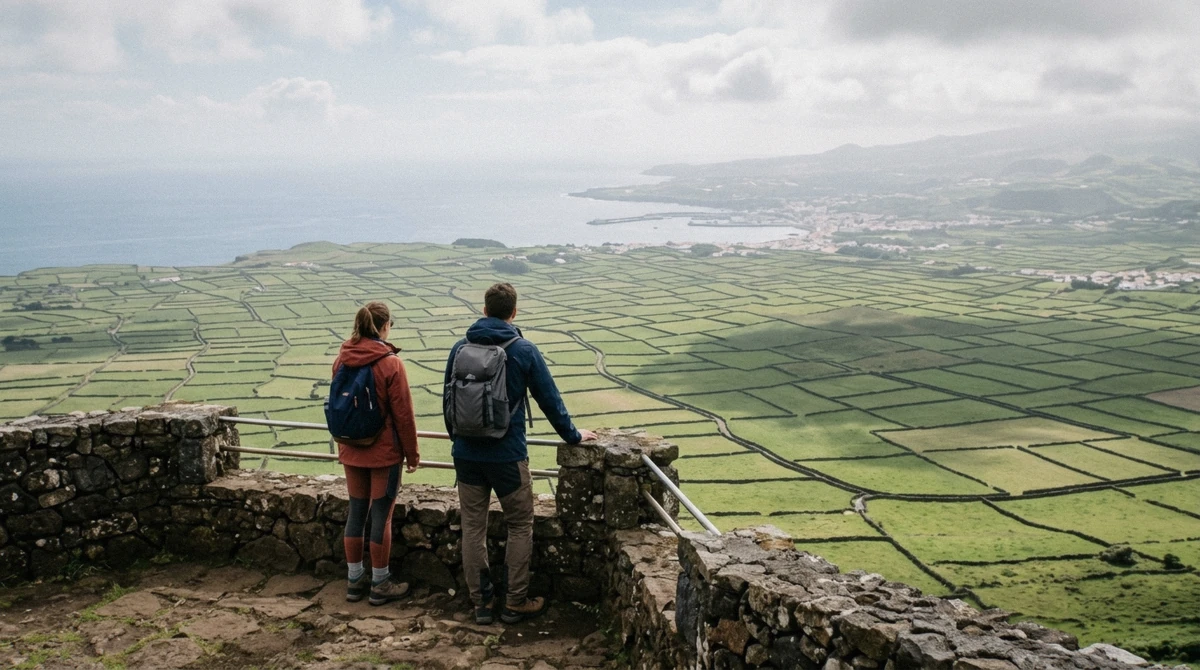
The easier rhythm. Terceira's sights, Serra do Cume's patchwork fields, the Furnas do Enxofre fumarole field, Monte Brasil's paths, sit within a short drive of one base, and two to three days genuinely finish the island. For travellers who measure a trip in towns and tables rather than trailheads, that is the better shape. The island's details sit in our Terceira guide.
What Each Island Costs on the Ground
Admission prices run close. Terceira's two Montanheiros caves charge $11.46 (€10) at Algar do Carvão and $10.31 (€9) at Gruta do Natal, with children under 12 free with a paying adult. São Miguel's signature tickets are the Furnas baths, $13.75 (€12) by day at Poça da Dona Beija and $19.48 (€17) at Terra Nostra, against which the island's viewpoints, tea estate and pineapple houses are free.
Guided days are near-identical: $97.57 for São Miguel's 8-hour west van tour, 4.9 from 2,270 reviews, against $99.87 for Terceira's full-day circuit, 4.7 from 333 reviews, with Angra's 3-hour walking tour at $51.66 as the smaller alternative.
Getting there is the number that moves. Ponta Delgada's published one-way fares run from $91.70 (€80) to Funchal and $132.90 (€116) from Lisbon, and Terceira is served from the same European network plus direct service from Boston, Toronto and Montreal. What neither island publishes is a ferry alternative from the other: Atlânticoline's route list simply does not include Ponta Delgada.
The Flight Arithmetic
Where you start decides half of this. From mainland Europe, both islands are straightforward, with Ponta Delgada carrying the wider network, from Lisbon, Porto, Faro and Funchal to Barcelona, Paris, Madrid, Frankfurt, Berlin and Düsseldorf. From North America the gap closes: Azores Airlines sells Boston and New York into Ponta Delgada, and Boston, Toronto and Montreal directly into Terceira, so a US East Coast traveller can choose either island without touching Lisbon.
Between the two islands, there is no boat. The ferries work the central triangle, and Ponta Delgada is not on the network, so São Miguel to Terceira means an Azores Airlines flight and an airport morning each way. That transfer cost is why one-island trips stay one-island, and why our how many days page sets the two-island threshold at a week.
One structural sweetener: the Azores Stopover programme adds 1 to 7 days in the islands at no extra airfare on North America to Europe bookings, which lets a Terceira stop become the added island on a long-haul itinerary rather than a second holiday.
Which One We Would Pick
For a first visit, São Miguel, without much hesitation. It has the archipelago's defining scenery, its most flexible flight network, the thermal baths, the whale boats and enough ground to fill four or five days. A traveller who sees Sete Cidades, Lagoa do Fogo and Furnas has seen the images that made them book the Azores in the first place.
Terceira wins for a specific set of travellers. Return visitors who have done the São Miguel circuit, anyone for whom a UNESCO city is the draw rather than a bonus, and North Americans who can fly in directly and would rather spend two dense days in Angra than four on a bigger island. It is also the calmer drive: fewer buses, fewer tour vans, more island under your own schedule.
The mistake to avoid is trying to split a short trip between both. With no ferry and an airport morning each way, a five-day holiday that touches both islands loses most of a day to logistics. Pick one, and let the islands guide plan the next trip.
So, São Miguel or Terceira?
If this is your first Azores trip of four days or more
São Miguel. The lakes, the baths and the whale boats are the archipelago's headliners, and the one-island itinerary fills every day without a flight.
If you have already seen São Miguel, or a UNESCO city is the draw
Terceira. Two to three days covers Angra do Heroísmo, the Algar do Carvão chimney and the island's viewpoints at a humane pace.
If you are flying from the US East Coast and want the shortest trip
Terceira has direct Boston, Toronto and Montreal service, so a long weekend works there in a way São Miguel's bigger geography does not allow.
If you cannot choose and have a week
Five nights on São Miguel, two on Terceira, one flight between. The shape is set out in our 7 day itinerary, and the islands guide covers the alternatives.
São Miguel or Terceira: Questions
Which island is better for a first visit to the Azores?
São Miguel, for most travellers. It concentrates the archipelago's signature sights, the Sete Cidades crater, the Furnas hot springs, year-round whale watching with sightings on 98 percent of trips, and enough ground for four or five days. Terceira is the better pick for a second trip, or for a first trip built around a UNESCO city and caves rather than viewpoints and baths. The island-by-island breakdown sits in our islands guide.
Is there a ferry between São Miguel and Terceira?
No. The Atlânticoline network serves ten ports, all in the central and western groups, and Ponta Delgada is not among them. The boats exist to work the Faial, Pico and São Jorge triangle, with long routes out to Graciosa, Flores and Corvo. São Miguel to Terceira is an Azores Airlines flight, and the operator publishes no static per-route fares, so the price comes out of the booking flow rather than a timetable page.
How many days do you need on Terceira?
Two to three. Angra do Heroísmo's UNESCO centre takes a day on foot, the Algar do Carvão chimney about 30 minutes on site plus the drive, and Serra do Cume, Furnas do Enxofre and Monte Brasil fill the corners of the same days. A 3-hour walking tour of Angra costs $51.66 if you want the city explained, and the full-island circuit runs $99.87. Our Terceira guide lays out the days.
Which island has the better food and town scene?
Different, not better. Angra do Heroísmo gives you a walkable UNESCO centre with restaurants and cafés inside 16th-century street geometry, which São Miguel's spread-out towns cannot match in one place. Ponta Delgada answers with scale: the municipal market, the pineapple houses with tasting rooms, the tea estate at Gorreana nearby, and the widest restaurant choice in the archipelago. If the evenings matter as much as the days, Angra is the more romantic answer.
Can I visit both islands in one week?
Yes, comfortably. Five nights on São Miguel and two on Terceira is the standard shape, connected by a direct Azores Airlines flight, and our 7 day itinerary is built around exactly that transfer. What a week does not absorb is a third island, because each inter-island move outside the ferry triangle costs an airport morning. Under a week, choose one island and stay.
Is the Algar do Carvão cave open normally?
Mostly, with a caveat worth checking before you plan a day around it. The official pages note the cave spent a period closed during construction of a new visitor centre, that visits resumed in March, and that short-notice suspensions remain possible while the works finish. Admission is $11.46 (€10), the visit is about 30 minutes down 338 steps, and summer hours run 14:00 to 18:00 daily. Current status and hours sit in our Algar do Carvão guide.
Both islands on video
Three films that show the two islands' different characters, which is the fastest way to feel the choice between big-and-famous and small-and-refined.
Sao Miguel Azores Travel Guide: 14 BEST Things To Do In São Miguel, Portugal (Ponta Delgada)
The full São Miguel case, made by its own highlights.
Video: Before You Go7 Days in the Azores (São Miguel Island)
A week's pacing on the big island, useful for the two-island split.
Video: Adriel LeroyThe Ultimate Azores Travel Guide 2025
Puts both islands against the rest of the archipelago.
Video: Easy Travel DudeLinked as published on YouTube. We have no connection to these channels.